How To Find Your Property On FEMA’s Flood Insurance Rate Maps

What are FEMA flood maps?
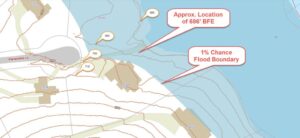
FEMA’s Flood Insurance Rate Maps (FIRMs) or just Flood Maps are provided after a flood risk assessment has been completed or updated for a community.  This study is known as a Flood Insurance Study.  The FIRM gives you the Base Flood Elevations (BFEs) and insurance risk zones in addition to floodplain boundaries.  The FIRM may also show a delineation of the regulatory floodway.

Once the “insurance risk zone”  (commonly referred to as the flood zone) is determined, actuarial rates, based on these risk zones, are then applied for newly constructed, substantially approved, and substantially damaged buildings.  FEMA uses these rates to determine the insurance rate you will pay for flood insurance

FEMA’s Digital Flood Maps

FEMA discontinued the production and distribution of paper flood maps in 2009 as part of its Digital Vision Initiative. This affected all the Flood Maps, boundary information, and study reports. However, clients can still view the products for free through their website or buy them in digital format.

To view these flood maps online, go to FEMA’s Map Service Center and key in your address (hi-lited area shown here) search for your home.  This will prompt you to then select the map that covers your area.  The Flood Maps are somewhat cumbersome to use online. It is best to go through the tutorial on the bottom right of the address search page for an easier and more effective use of the GIS map.

author avatar
Surveyor

More Posts

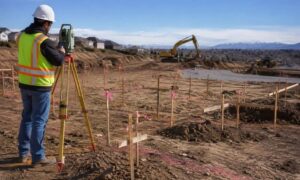
Land surveyor using a total station to mark construction staking points on an active job site before foundation and site development work begins
construction
Surveyor

What Is Construction Staking and Why Does It Matter?

Construction staking is a surveying process that marks the location and elevation of a structure on a job site before building begins. It turns plans on paper into real points on the ground so builders know exactly where to dig, grade, and build. Construction staking is one of the most

Read More »
Aerial view of a new housing subdivision with empty rectangular lots and grid streets surrounding a central cul-de-sac, nearby completed homes visible nearby.
civil engineering
Surveyor

Subdivision Planning: Why Water Supply Affects Lot Approval 

Most people think land size and zoning decide how many lots they can create. That sounds right at first. Still, in Denver, water often makes the final call. Water supply has become a real limit for new development. Local agencies now look closer at how much water a new subdivision

Read More »
Surveyor measuring property lines in a residential yard before building a fence
boundary surveying
Surveyor

Boundary Survey for Fence Permits: Before You Build 

You’re ready to build a fence. You picked the design, talked to a contractor, and set a budget. Everything feels simple at first. Then the permit comes into play. At that point, many homeowners in Denver realize they don’t have clear information about their property lines. They may have a

Read More »
Civil engineer reviewing site plans with a contractor during a project discussion
civil engineering
Surveyor

When Do You Need a Civil Engineer for a Drainage Report?

You start a project expecting it to move fast. Plans are ready, and the design looks clean. Then the city reviews your submission and asks for a drainage report. It catches you off guard. Everything slows down, and this is usually when a civil engineer is brought in to help

Read More »
Side-by-side view of a sloped lot and a lidar mapping view showing elevation changes across the land
land surveying
Surveyor

How to Use Lidar Mapping Data to Evaluate Sloped Lots

Buying a sloped lot can feel like a smart move at first. The views are better, the space feels open, and the land often looks more private. Still, that same slope can bring problems that don’t show up right away. Many people walk on a property, like what they see,

Read More »
Surveyor reviewing site plans at a construction site to assess soil conditions for a geotechnical engineering report
civil engineering
Surveyor

How Old Is Too Old for a Geotechnical Engineering Report?

You found an old report. It looks solid. It even shows your property. So you include it with your permit and expect things to move forward. Then the city pushes back. That catches a lot of people off guard. Most assume the report still holds up, but the ground doesn’t

Read More »