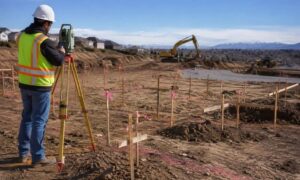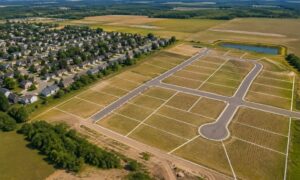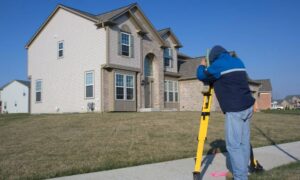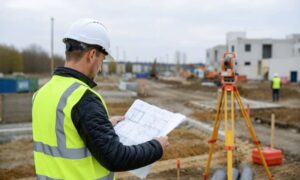
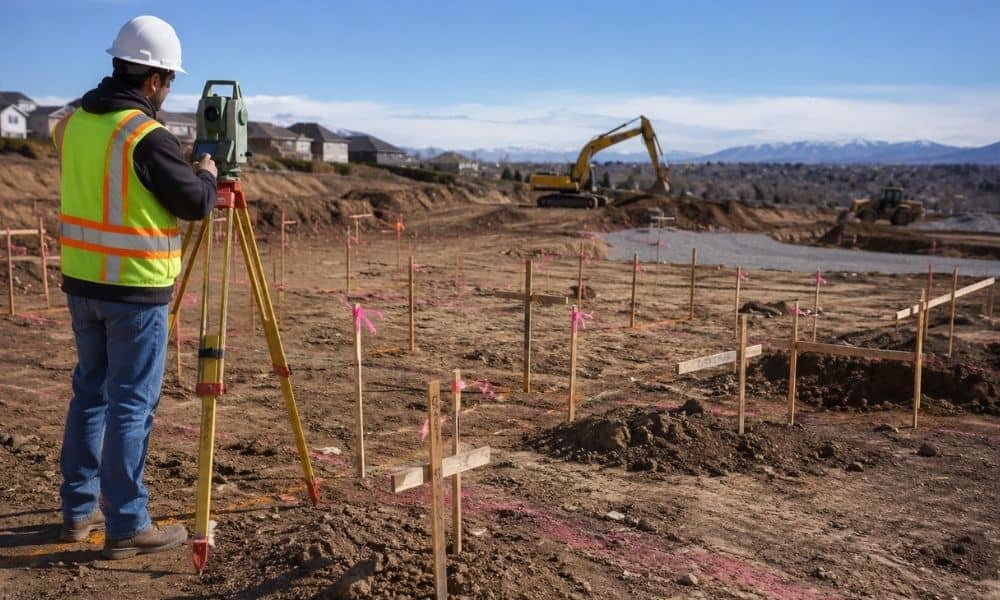
Construction staking is a surveying process that marks the location and elevation of a structure on a job site before building begins. It turns plans on paper into real points on the ground so builders know exactly where to dig, grade, and build.
Construction staking is one of the most important steps in any building project. Before any digging starts, a licensed surveyor places markers across the site. These markers guide every contractor and engineer. They show where buildings, roads, and utilities must go. Without construction staking, even a perfect plan can go wrong fast.
What Is Construction Staking?
Construction staking turns engineering drawings into physical points on the ground using stakes and flags. It tells contractors exactly where to build, including the horizontal position and vertical elevation of each structure, before any earth is moved.
Construction staking is also called “construction layout” or “site staking.” A licensed surveyor does this work after the design is finished but before construction starts. The surveyor uses the approved site plan and places physical markers on the land. These markers show:
- Where buildings and foundations go
- Where utilities like water and sewer lines run
- Where roads and curbs will be built
- How much soil needs to be added or removed
In Denver, where new development is growing fast, construction staking makes sure that what was approved on paper gets built in the right place.
How Does Construction Staking Work?
A surveyor starts with the approved engineering drawings and uses GPS or a total station to locate key points on the site. They place stakes at each location and write notes showing distances and elevations so every crew member knows what to do at each point.
Step 1: Review the Plans
The surveyor studies the civil engineering drawings and site plan. All work is tied to a known reference point called a benchmark.
Step 2: Set Control Points
Using GPS or a total station, the surveyor sets control points across the site. These points are the starting framework for all other staking.
Step 3: Place the Stakes
Stakes go at key locations. Each stake is marked with:
- How far it is from the actual build point
- How much soil to cut or fill to reach the right height
Step 4: Deliver Cut Sheets
The surveyor gives the crew a cut sheet. This is a written record of every stake, its location, and the grade information. Crews use this to read each marker on the site.
Types of Construction Staking
The main types of construction staking are rough grading, building layout, utility, road and curb, and finish grade staking. Each type guides a different phase of the construction process and requires a different level of precision.
- Rough Grading Staking – Placed before earthwork. Shows where land must be cut or filled.
- Building Layout Staking – Marks the exact corners and edges of a structure. Used by excavation and foundation crews.
- Utility Staking – Marks where underground pipes and conduits go. Very important in Denver’s busy urban areas.
- Road and Curb Staking – Marks centerlines and edges for road and curb construction.
- Finish Grade Staking – Fine-tuned staking done after rough grading for final surfaces like parking lots.
Why Does Construction Staking Matter?
Construction staking is the only step that connects a design plan to the real world. Without it, buildings can end up in the wrong spot, inspections fail, utilities conflict, and rework costs rise fast. It protects the project, the budget, and the property.
It Prevents Costly Mistakes
The Construction Industry Institute found that rework accounts for about 9% of total project costs. A foundation placed just a few feet off can mean:
- Tearing out and redoing concrete
- Resubmitting permits to the City of Denver
- Moving utilities that conflict with the new layout
- Delays that affect every trade on the job
It May Be Required by Law
Many cities, including Denver, require surveyor-certified staking before issuing grading or construction permits for commercial and multi-family projects.
It Protects Your Property Lines
Construction staking ties directly to your boundary survey. If a building is placed wrong relative to the property lines, it creates an encroachment. That means legal disputes, title issues, and possible forced removal.
It Keeps Projects on Track
When grading, excavation, and framing crews all start with accurate staking, there are no costly stops caused by layout confusion.
What Happens If You Skip Construction Staking?
Skipping construction staking is one of the most expensive decisions a builder can make. Real consequences include:
- Buildings built in the wrong location
- Drainage that flows toward structures instead of away
- Utility conflicts that require extra excavation
- Failed city inspections
- Legal problems from structures crossing property lines
A McKinsey study found that large construction projects run 80% over schedule and 20% over budget on average. Poor pre-construction planning, including layout errors, is one of the top causes.
How Much Does Construction Staking Cost?
Construction staking typically costs between $500 and $2,500 for residential projects and $3,000 to $15,000 or more for commercial work. The price depends on site size, terrain, number of staking phases, and how quickly the work is needed.
Cost factors include:
- Project type (residential vs. commercial)
- Site size and slope
- Number of staking phases required
- Site access and terrain
- Rush scheduling
Construction staking is almost always a small part of total project costs. And it costs far less than fixing a layout mistake mid-build.
Frequently Asked Questions
What is the difference between construction staking and a boundary survey?
A boundary survey finds and marks the legal property lines of a parcel. Construction staking uses those lines, plus an approved site plan, to mark where improvements will be built inside those boundaries.
Is construction staking required in Denver?
For most commercial, multi-family, and infrastructure projects, yes. Denver’s permit process typically requires surveyor-placed staking before earthwork inspection. Check with your permit office or project engineer to confirm.
Who performs construction staking?
Only a licensed Professional Land Surveyor (PLS) can perform or certify construction staking. In Colorado, practicing land surveying without a license is illegal.
What is a cut sheet in construction staking?
A cut sheet is a written record from the surveyor that lists each stake location, its offset from the true build point, and the cut or fill amount needed to reach the correct grade. Crews use it to interpret every marker on the site.
Can GPS replace traditional construction staking?
GPS machine control systems can reduce the number of physical stakes needed. But a licensed surveyor still sets up the control network and certifies the work. GPS changes how data is delivered. It does not remove the need for a surveyor.