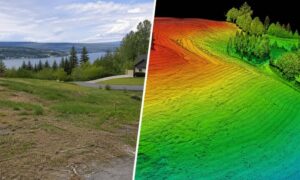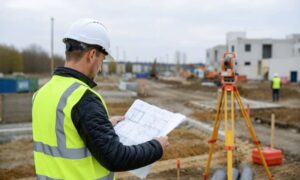
Not every drone map counts as a true survey. In fact, many drone images look sharp and detailed, yet they do not meet the standards engineers need for design. That difference matters, especially in Denver. Here, small elevation changes can affect drainage, foundation design, and even permit approval. Because of that, survey-grade accuracy is not optional. It is essential. So how do professionals achieve real survey-grade results in drone land surveying for urban projects? It starts long before the drone ever leaves the ground.
What “Survey-Grade” Really Means
First, let’s clear something up. Survey-grade does not mean “close enough.” It means the data meets strict accuracy standards. Engineers rely on this data to design roads, parking lots, drainage systems, and building pads. If the elevations are off, even by a few inches, problems can follow.
For example, a parking lot that slopes the wrong way can hold water. A foundation poured on incorrect grades can lead to cracking. Therefore, survey-grade drone land surveying focuses on precision from start to finish.
In Colorado, survey data must also align with proper coordinate systems. Most projects use NAD83 for horizontal control and NAVD88 for elevation. If the data does not match those systems, engineers cannot use it confidently. That is why professionals confirm coordinate systems before any flight begins.
Ground Control: The Backbone of Accuracy
Next comes one of the most important steps: ground control.
Even if a drone uses RTK or GPS correction, urban environments create challenges. Downtown Denver has tall buildings, metal structures, and signal reflections. These factors can distort satellite signals. As a result, relying only on onboard GPS can introduce small but costly errors.
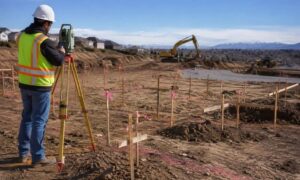
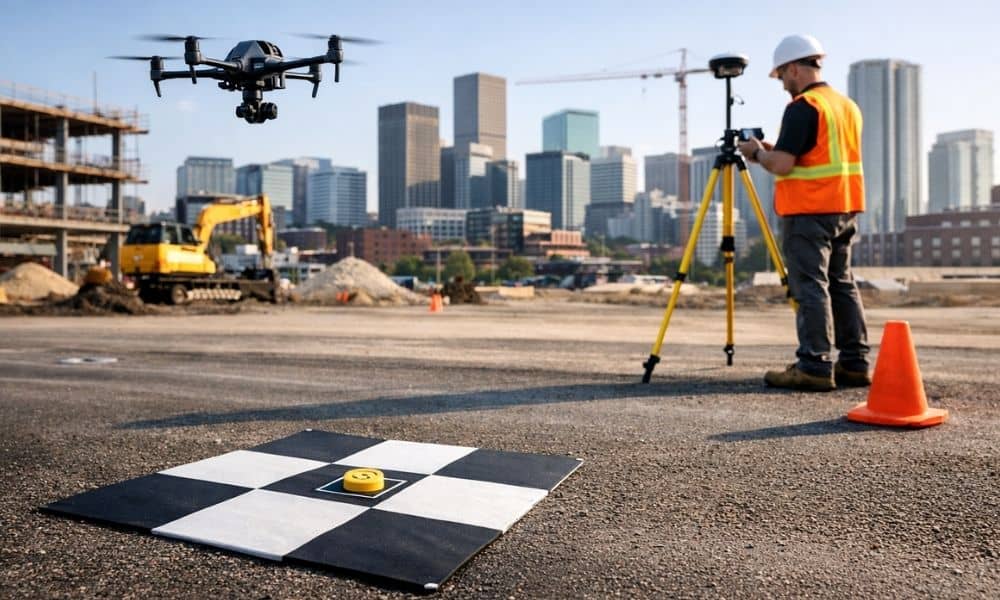
To prevent that, survey teams place Ground Control Points (GCPs) across the site. These are clearly marked points measured with high-accuracy equipment. They anchor the drone data to real-world coordinates.
However, smart placement matters. Crews position control points around the edges and inside the site. They also add independent checkpoints to verify results. This step confirms the drone data matches known elevations.
Because of this control network, drone land surveying can meet engineering standards instead of just producing a nice aerial image.
Choosing the Right Sensor for the Job
Not all projects require the same tools. In fact, sensor choice plays a major role in accuracy.
Photogrammetry works well for hard surfaces. For example, paved lots, rooftops, and open construction sites respond well to high-resolution imagery. The software turns overlapping images into a detailed surface model.
However, tree cover and uneven ground create problems for image-only methods. In that case, LiDAR becomes the better option. LiDAR sends laser pulses to the ground and can capture elevation even through light vegetation.
Denver projects often include mixed terrain. A site might have pavement, trees, and disturbed soil all in one parcel. Therefore, professional drone land surveying teams evaluate the terrain first. Then they choose the sensor that delivers the most reliable elevation data.
That decision affects everything that follows.
Turning Raw Data Into Engineering-Ready Surfaces
Flying the drone only captures raw information. The real work begins in processing.
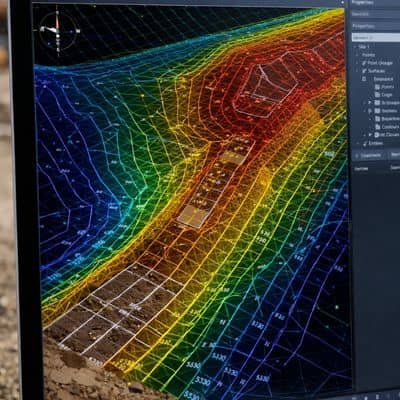
First, technicians clean the point cloud. They remove noise, stray reflections, and elevation spikes. Without this step, contours can appear wavy or distorted.
Next, they define breaklines. Breaklines mark sharp changes in elevation, such as curbs, edges of pavement, and retaining walls. These lines guide the surface model and prevent smoothing over important features.
Then, they generate contours that match project standards. Engineers often request one-foot or two-foot intervals. Clean contours allow them to design grading plans with confidence.
Finally, the team exports files in formats compatible with Civil 3D and other design software. Organized layers and verified coordinates save engineers hours of correction time.
At this stage, drone land surveying moves from visual mapping into true engineering support.
Managing Urban Colorado Challenges
Urban Colorado projects bring unique obstacles. For example, Denver’s elevation affects drone performance. Higher density altitude can reduce lift, especially on hot summer days. Therefore, flight planning must account for temperature and battery performance.
Wind also plays a role. Buildings create wind tunnels that affect flight stability. Skilled pilots plan flight paths that reduce drift and overlap loss.
Snow cover creates another challenge. Snow can hide ground features and distort elevation readings. For that reason, survey teams schedule flights when ground conditions allow accurate modeling.
Airspace rules also require attention. Areas near Denver International Airport and other restricted zones demand careful coordination. Professional teams check FAA maps and obtain any required approvals before flying.
By managing these details, crews protect the accuracy of the final survey.
Quality Checks Before Delivery
Even after processing, the job is not finished.
Teams compare drone elevations against independent checkpoints. If discrepancies appear, they investigate and adjust. They review residual error reports and confirm that tolerances meet project requirements.
This quality assurance step separates professional drone land surveying from hobby-level mapping. Instead of assuming the data looks right, surveyors prove it meets standards.
Only after passing these checks does the team deliver files to the client.
What Clients Should Look For
If you are planning a project, ask a few simple questions before hiring a drone land surveying firm.
- Do you operate under a licensed Professional Land Surveyor?
- What vertical accuracy can you certify?
- Do you use ground control and independent checkpoints?
- Will the files align with Colorado coordinate systems?
- Are the deliverables ready for Civil 3D?
Clear answers show that the firm understands survey-grade standards.
Accuracy Is a Process, Not a Gadget
At the end of the day, a drone alone does not guarantee precision. The workflow creates accuracy. Ground control, correct coordinate systems, proper sensor choice, and detailed processing all work together.
Urban Colorado projects demand that level of care. Small elevation errors can lead to redesigns, delays, and extra costs. On the other hand, survey-grade drone land surveying gives engineers solid data from the start.
When professionals follow the full process, they deliver more than an aerial map. They deliver reliable information that keeps projects moving forward with confidence.
And in a growing city like Denver, that accuracy makes all the difference.